

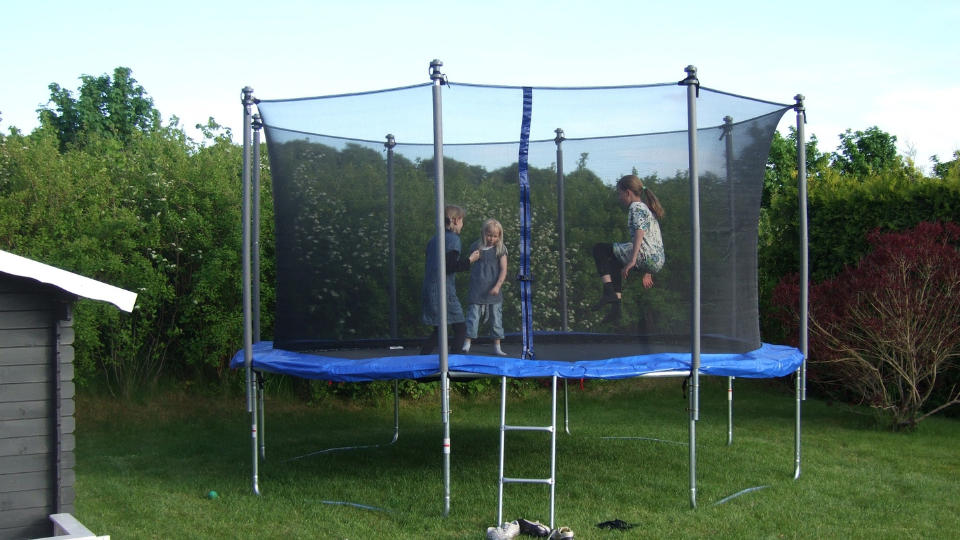
Most trampolines stop getting used long before anyone gets rid of them. The kids outgrew it, or a storm bent the frame, or it’s just been sitting in the corner of the yard collecting leaves for three years while everyone agrees it should probably go.
Then you actually try to get rid of it.
Why it can’t go at the curb
Size and material. Most municipalities in Georgia don’t take oversized bulk items like trampolines through regular curbside collection. The frame is too large for standard collection trucks, and the mat and padding aren’t recyclable through any residential program.
Leaving one at the curb without arranging pickup usually means it sits there. In some HOA communities, it also means a violation notice.
So it has to come apart first.
What disassembly involves
A standard backyard trampoline breaks down into three parts: the steel frame, the springs, and the mat with its padding.
The frame is the heavy part. It comes apart at bolted or friction-fit joints, and on anything that’s been outside for a few years, those joints are rusted. That turns a 30-minute job into a longer one. A socket set, a rubber mallet, and penetrating oil all help.
The springs come off one at a time, and there are usually somewhere between 72 and 96 of them. A spring pull tool makes this manageable. Most people don’t own one, though hardware stores carry them. Pliers work, but slowly, and your hands will let you know about it later.
Once the springs are off, the mat and padding lift away easily. Those are the simple parts.
What you’re left with is a pile of steel and vinyl that still has to get somewhere.
Where the parts go
The frame and springs are scrap metal. Recyclers take them, and depending on where scrap prices sit that week, you might get a small amount back. You transport it yourself, and since a trampoline is essentially all steel, there’s no sorting to worry about.
The mat and padding are a harder problem. The mat is typically polypropylene mesh and the padding is foam wrapped in vinyl. Neither goes through standard recycling, and donation centers won’t take them once they’ve weathered. Those go to the landfill, along with the enclosure net if you have one.
Where people misjudge the job
Disassembly runs long on older trampolines, which is the part most people account for. Transportation is the part they don’t.
Broken down, the frame sections are still long and awkward. They don’t fit in a sedan or most SUVs. You need a truck or a trailer, and depending on size, you may be making two separate trips: one to a scrap yard for the metal, one to a transfer station for everything else.
If the trampoline is part of a larger yard cleanup, which it usually is, the whole project expands from there.
Most people who handle it themselves lose most of a Saturday. That’s not a reason to avoid it, but it’s worth knowing before you start at 9 am thinking you’ll be done by lunch.
When to just call someone
If you’ve got the tools, a truck, and the day free, doing it yourself is reasonable. The scrap value won’t cover much, but it’s not nothing.
If you don’t have a way to haul it, or the frame is badly rusted, or the backyard has other things that also need to go, trampoline removal is faster than most people assume. A crew can break down and load a standard trampoline in about an hour, take the steel to a recycler, and dispose of the rest.
It’s also cheaper than people expect. Because the frame has scrap value, trampolines are one of the more straightforward jobs on the residential side.
TopDawg handles trampoline removal across Athens and Atlanta with same-day and next-day availability. Book online or call (706) 613-4135 in Athens or (404) 236-6656 in Atlanta.